

Battery power
-
- from Shaastra :: vol 05 issue 09 :: Sep 2026

Spotlight on new-generation batteries that will replace lithium for several applications in the future.
In 1973, members of the Organization of the Petroleum Exporting Countries (OPEC) got together to protest the support of the Western nations, including Japan, for Israel in the Yom Kippur War. They banned oil exports to the U.S., Europe and Japan and increased the price fourfold to nearly $12 a barrel. The 1973 oil shock, as the incident is now often called, reverberated worldwide and made several countries and corporations reassess their dependence on Arab oil. One of them was Exxon, the American oil company.
Exxon was a rich company with enough profits that could fund unusual ideas and deep research. Exxon had hoped that some of these projects, if they succeeded, would help it transform into an energy company rather than an oil company. Exxon had planned this transformation before the oil shock. The company feared that global oil production would peak by the turn of the century and began hedging its bets by investing in renewable energy. A year earlier, it hired chemist Stanley Whittingham to work on energy storage. Within a few years of the oil shock, Whittingham had developed the world's first rechargeable lithium-ion cell.
It wasn't a saleable battery. Whittingham had found a non-intuitive way of making an anode made of pure lithium give up ions into a cathode, but it was not stable, and was prone to catching fire. As the battery was repeatedly recharged, lithium ions, which were to move from the cathode back into the anode, would not move smoothly into their original homes. Instead, they would grow dendrites on the anode. Over the next decade, two other research groups took Whittingham's invention and developed a safe, useful battery. One was led by John Goodenough, who left the MIT Lincoln Laboratory after 24 years because U.S. government funding was terminated. Goodenough changed the material in Whittingham's cathode from titanium sulphide to lithium cobalt oxide, a safer material that also doubled the battery's output. The second research group, led by Akira Yoshino, an engineer at Asahi Kasei Corporation in Japan, replaced the battery's pure lithium anode with petroleum coke.

This month's Cover Story is the first comprehensive narrative in Shaastra on the state of novel battery research in India.
The first lithium-ion battery was sold in 1991 through a commercial partnership between Asahi Kasei and Sony, as part of the camcorder that Sony sold. The three scientists behind the lithium battery story were awarded the Nobel Prize in 2019, by which time the world had already experienced the extraordinary potential of lithium-ion batteries. These batteries were everywhere: in laptops, mobile phones, wearable devices, personal care devices like toothbrushes and shavers, power tools, and electric cars. From the oil shock to the Nobel Prize took 46 years. Meanwhile, the lithium-ion battery continued evolving, becoming safer and more efficient at storing charge. It will continue to evolve.
Our Cover Story, by T.V. Jayan, narrates the beginning of another story: new-generation batteries that will replace lithium for several applications in the future. Lithium ions can be packed more closely than those of any other material. This property, combined with other electrochemical properties, makes it the best material for rechargeable batteries. However, useful as lithium is, it is expensive and unevenly distributed. Looking into the future, nations want to avert a lithium shock much like the oil shock. So, like Exxon, they began other battery projects more than a decade ago. Our Cover Story describes some of these developments in India, especially those with commercial potential. Some of these batteries, especially sodium-ion, can be the backbone of renewable energy storage in a decade or less.
The story of the lithium-ion battery shows that technological innovation happens over long periods, through incremental advances as well as sudden bursts of innovation. Shaastra has, in several of its stories, showcased recent progress in batteries. This Cover Story is the first comprehensive narrative on the state of novel battery research in India. With battery innovation advancing rapidly, we are certain this will not be the last.
See also:
Taking charge
Back to the board
One for the road
Power to the people
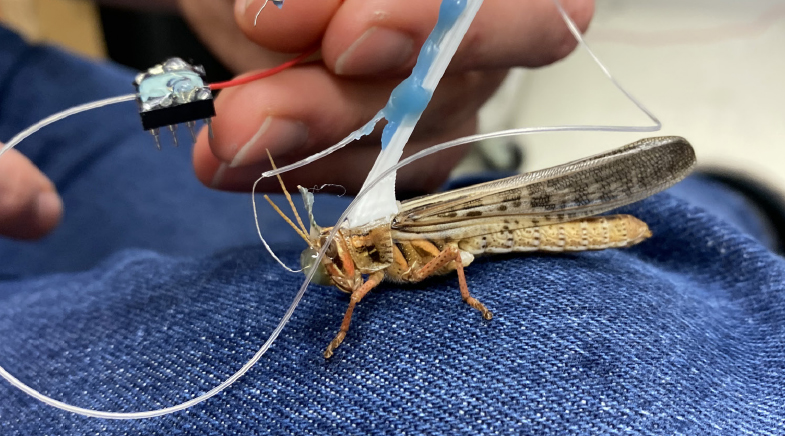








Learning from locusts
Scientists are pushing human olfactory limits with the help of bugs.


Up in the air
From the albatross to the featherwing beetle to the dandelion, the physics of flight is the outcome of evolution over millions of years.

Ideas with a vision
Easing ECG tests, cotton farming and lab lessons.



Have a
story idea?
Tell us.
Do you have a recent research paper or an idea for a science/technology-themed article that you'd like to tell us about?
GET IN TOUCH