

Light is right
-
- from Shaastra :: vol 05 issue 08 :: Aug 2026

Technology is helping products shed weight, optimising safety and energy.
Colonel Satish Mallik lost his left leg on May 26, 1999, when he stepped on a landmine during the Kargil War. It took six hours for a rescue team to bring him to the nearest army hospital in Rajouri, Jammu. Surgeons amputated his leg below the knee, and Mallik got his first artificial limb three months later. He was 33 years old.
The incident didn't rob Mallik of his zest for living. He had grown up loving the outdoor life — biking, hiking, photography — but first he had to get used to using the external appendage. The artificial leg had a thick resin-coated fabric socket, a solid wooden block as the leg, and a foot with a wooden core and rubber layers. It weighed 7 kilograms. It was an exoskeleton; the hard outer shell — like that of a car — bore the load, an inefficient design that needed thick, strong material. Despite having to carry the extra weight, Mallik continued his outdoor life. He kept hiking and cycling.
Five years later, Mallik got an endoskeleton design. The load was borne by a central inner rod made of a steel tube with steel adaptors, somewhat like a cycle frame. The socket was of nylon layers; one carbon fibre layer was hardened with resin, while the foot material remained the same. It was lighter than the exoskeleton and more efficient at resisting load. In February 2025, Mallik got another upgrade: an endoskeleton with a socket made of glass fibre impregnated with resin, adaptors made of steel, a connecting tube of aluminium and a carbon fibre foot with a rubber shell. "It can also store energy when I'm walking and give me a push that makes it much more comfortable and much easier to walk with," Mallik says, explaining the spring-like action of carbon fibre feet. It weighs just over 3 kilograms.
Over a million years or so, evolution has perfected human walking styles. The human gait is energy-efficient; an artificial limb is not. Research from the Massachusetts Institute of Technology, conducted 12 years ago, has shown that amputees wearing a conventional prosthesis require up to 30% more metabolic energy to walk at the same speeds as non-amputees (bit.ly/amputee-energy). "That's the reason why the artificial limb needs to be lighter and contribute more to saving energy," says Brigadier C.N. Satish, a prosthetic surgeon and Commandant of the Pune-based Artificial Limb Centre, established in 1944 to provide prosthetics and care for injured soldiers of the British Indian Army.
Reduction in the weight of implants improves acceptance by the body. Lighter gear enhances an athlete's sports performance and the agility of soldiers.
Over the past two decades, improved materials, better design and increased knowledge of the human gait have made artificial limbs more comfortable and lighter. Aluminium can approach some forms of steel in strength. It has one-third the density of steel but is not an easy material for artificial limbs as it cracks after repeated use. Driven mostly by the need to develop light electric cars, aluminium technology has improved significantly in the past decade, providing a spin-off benefit to amputees. Prices of high-strength carbon fibre composites have been dropping over the past decade. Manufacturing technologies have improved, too. Over the years, manufacturing innovations such as precision moulding, CNC machining, and 3D printing have enabled better material distribution at load-bearing sites, creating lattice and porous structures. For a large number of products beyond artificial limbs, making structures light has become a necessity. "Lightweighting is important for three reasons," says Saurabh Nene, Associate Professor at the Indian Institute of Technology (IIT) Jodhpur. "One is for energy, the second is for safety, and the third is for sustainability."
Light vehicles provide more range and use less fuel. Lighter electronics improves portability and user comfort. Light construction materials are easier to transport and faster to build. Lighter structures can withstand seismic forces better than heavier ones. Reduction in the weight of implants improves acceptance by the body. Lighter gear enhances an athlete's sports performance and the agility of soldiers during war.
Making materials light has become a global movement touching a substantial number of human activities. With sustainability goals in mind, Germany started its 'Lightweighting Initiative' in 2021 to promote material research and manufacturing technologies that lead to light products. In a similar vein, the European Lightweighting Network brings together Germany, Austria, Sweden, Belgium, Poland, Spain, and Slovakia to promote cross-border research and industrial adoption of technologies to create light products. Japan and South Korea, home to major car manufacturers, are also funding material research initiatives that yield light materials for vehicles. Across the world, green initiatives on zero emissions, energy efficiency, clean mobility and decarbonisation are all spurring the development of light materials and products.

With modern tools and technologies by their side, scientists are developing lightweight alloys, advanced carbon fibre composites, distinct aerogels and using nanomaterials to add functionality and reduce material usage. Enabling them are modern digital tools such as generative artificial intelligence (AI), topology optimisation tools, finite element analysis, digital twins, parametric CAD and lattice design software. Additive manufacturing technologies, better adhesives to join and weld parts, and hybrid and multi-material manufacturing are enabling mass production of optimised lean structures and products. According to Grand View Research, a business consulting firm, the global market size of light materials, estimated at $197.1 billion in 2024, is projected to reach $339.8 billion by 2030 (bit.ly/material-market).
AS THIN AS AIR
An aerogel is a material as close to thin air as possible. It is made when the water in a gel — actually 99% of the substance — is evaporated without letting it collapse into a powder. Aerogels are like a contradiction in terms: with a lot of material and wisps of air at the same time. They have high surface area, ultralow density, low thermal and electrical conductivity, and a host of other properties, while being the lightest substance on Earth. They let light through and develop a bluish tinge, just the way smoke looks when light is shone through it. You can hold an aerogel in hand, but smoke seeps through the fingers. This frozen smoke had been a scientific curiosity for long. Now it is becoming an important element for a sustainable future.
Ankit Jhanwar hadn't thought much of aerogels during his Master's programme in polymer science at IIT Roorkee. No one made them in India, and manufacturers were few even in developed markets. Aerogels were not easy to manufacture, a fact that limited their applications even nearly a century after discovery. Jhanwar worked in the thermal storage and polymer industries for over a decade and had begun to feel restless. After some staggered attempts at entrepreneurship, he founded DashamLabs in 2024. He had hit upon aerogels as a possible business area while working on DashamLabs. Before he could find customers, however, he had to find a good way of manufacturing it. "Aerogel is risky to make, difficult to execute, but if you get it right, there's just simply so much demand," says Jhanwar.
The market size of light materials, estimated at $197.1 billion in 2024, is projected to reach $339.8 billion by 2030.
Early on, he had decided that his company wouldn't try to develop the technology in-house. A search led him to the International Advanced Research Centre for Powder Metallurgy and New Materials (ARCI) in Hyderabad. Neha Hebalkar, a scientist at the institute, had developed a novel method of manufacturing aerogels that had not yet been commercialised. As a one-year-old company, DashamLabs didn't have the money to buy the technology but, in 2025, Speciale Invest, a venture capital firm, put in ₹12 crore in a seed round. The technology was transferred from the institute to DashamLabs, with Hebalkar continuing as an advisor (bit.ly/Shaastra-Dasham).
Dasham uses a proprietary method for making silica aerogel, where ethanol, instead of carbon dioxide, is used for a high-pressure drying process, with full recovery of ethanol at the end. This ethanol can be reused, making the solvent cost negligible. The resulting silica aerogel has lower thermal conductivity than those available in the market. The manufacturing, however, is quite risky, as the process involves the use of ethanol, a flammable solvent that needs to be heated to 260° Celsius at 80 times the ambient pressure. "It's like a ticking time bomb if ethanol leaks," says Jhanwar. He adds that the entire manufacturing plant is equipped with sensors to detect an ethanol leak; a blast-proof wall has been made around the pressure vessel; and all equipment is fire-resistant. It is set to go from batch production to full-scale manufacturing later this year at the company's plant in Bawal, Haryana. "The technology has not been exploited yet fully. There's still a 40-year journey left to be exploited fully," he adds.
While work on aerogel was held up due to hazardous manufacturing procedures, carbon fibre composites lagged because of manual manufacturing techniques. High-strength and low-density carbon fibre composites — made by embedding carbon fibres in polymers — are valuable in various applications but are now used mostly in aerospace, defence, and energy. "Composites are fairly new for us. The manufacturing technology hasn't really caught up to what kind of maturity the metals or plastics have got," says Dhinesh Kanagaraj, CEO of Chennai-based Fabheads Automation.

Kanagaraj was working as an aerospace engineer in the Indian Space Research Organisation (ISRO) when he encountered significant delays in their orders of carbon fibre composite aircraft parts. He was shocked to learn that this delay was due to the manual manufacturing process. "It was almost like pottery," he says. Carbon fibre composites derive their strength when carbon fibres are aligned in one direction. Therefore, they cannot be melted and poured into moulds like plastics or metals. The workers cut the fibre sheets manually, place them layer by layer into moulds, align them in the direction in which strength is required, apply resin, remove air bubbles, cure it and trim the parts manually. Kanagaraj realised that scale could not be achieved if this process remained manual. So, he left his job at ISRO and started Fabheads Automation to automate the manufacturing of carbon fibre composites. "We wanted to develop a more automated process because the current process is time-consuming, expensive, and unreliable," he says.
The manufacturing of carbon fibres was manual because the fibres broke during machine handling. To prevent this, Fabheads processed the material before being handled by a machine or a robot. Their proprietary technology, Adaptive Tow Placement (ATP), uses a robot to place continuous fibre strands along optimised paths and directions based on the shape and load requirements of the part being developed. While manual placement allowed only a few angles, the robotic system allows fibre strands even along curved geometries if desired. The automated process is faster, yields products of a consistent quality, reduces material wastage and enables scale.
Kanagaraj says that as the manufacturing barrier is being slowly overcome, the carbon fibre composites are now beginning to be seen in ships and automobiles. Composites make vehicles fuel-efficient and safer, but due to their high cost, they are currently limited to luxury and sports cars. "The whole chassis of an F1 car is made with carbon fibre. It absorbs a lot of impact energy, doesn't transfer all of it to the driver. So, the driver is inherently safer inside a carbon fibre car compared to a metal car," he says. Kanagaraj adds that the front part and the bumper regions of vehicles are gradually being made with glass fibre or carbon fibre systems for safety.
Over the years, engineers have developed better manufacturing technologies that are reducing both the material and weight of products. Tesla and other automakers use gigacasting to manufacture vehicles, where massive high-pressure die-casting machines are used to produce large, single-piece structural components. This reduces weight by consolidating parts and eliminating heavy joints and welding that are conventionally used to tie parts together. Manufacturers are no longer stuck with a single material, as technologies like multi-material 3D printing and hybrid joining enable different materials to be combined into one product. Companies such as Sika Automotive in Switzerland have developed adhesives to replace bulky, heavy mechanical fasteners, including welds and rivets, with bonding for joining different materials. The manufacturing revolution enables weight reduction.
ALLOYS DRIVE WEIGHTS DOWN
Nene of IIT Jodhpur began his research on light alloys in 2012 while at the IITB-Monash Research Academy. Magnesium was then a popular material for making light devices. Magnesium is light, biocompatible, and biodegradable, properties that help make it suitable for dissolvable implants that do not need to be removed through a second surgery. However, because the element breaks easily, it can't be pulled into wires or bent. During the manufacturing process, it is hard to shape it into different geometries without cracking or tearing it. Magnesium corrodes rapidly too. To improve these properties, Nene added 4% lithium and 1% calcium to it. It also made the implants lighter, because lithium weighs less than magnesium.
Now, at his laboratory in IIT Jodhpur, he has shifted his research to making alloys for ballistic applications and hence to titanium alloys. Light and high-strength carbon fibre-reinforced polymers are now replacing metals for making aircraft bodies. However, their poor resistance to high temperatures limits their use in aircraft parts such as combustors, turbine blades, turbine discs, and exhaust sections that experience high temperatures during take-off. So, metal alloys have stayed relevant for such applications. Nene wanted to replace heavy but temperature-resistant nickel superalloys with a light titanium-and-aluminium alloy of a lower density.
The material thus developed — the titanium-aluminium alloy with a variety of added materials such as niobium, molybdenum, tantalum, tungsten, and vanadium — has half the density of the nickel superalloy while retaining its properties (bit.ly/superalloy-properties). It costs half as much as the nickel superalloy. A turbine made of this material will provide two advantages: it will give more thrust in less fuel. "If we reduce the weight of every aircraft by 1-2%, the reduction in fuel consumption will result in the availability of fuel for another decade," Nene says.
ALLOYS FOR HEALING
Magnesium alloys continue to find uses in healthcare. Kaushik Pal, a nanotechnologist and Professor at IIT Roorkee, was interested in developing an implant using light and biodegradable magnesium, but its rapid degradability, corrosion and poor strength were his concerns. In 2025, he developed a metal composite by adding 2% each of hydroxyapatite, nano cerium oxide and zinc-manganese-calcium alloy powder in 94% magnesium. Cerium oxide nanoparticles increase strength, hardness and corrosion resistance, while hydroxyapatite helps the implant integrate with bones. The alloy powder increases strength, ductility and corrosion resistance while remaining biocompatible. The resultant composite showed an 80% increase in hardness, 148% higher corrosion resistance and 236% more strength to endure weight than magnesium alloys. It could be used for orthopaedic implants, such as bone screws, plates and pins, that support fractured bones during healing and then gradually dissolve, eliminating the need for a second surgical procedure to remove them. Pal believes that metal composites allow engineering implants for their specific application. "We can engineer an implant for a certain time, say three months or six months or maybe nine months to 12 months like this," he says.
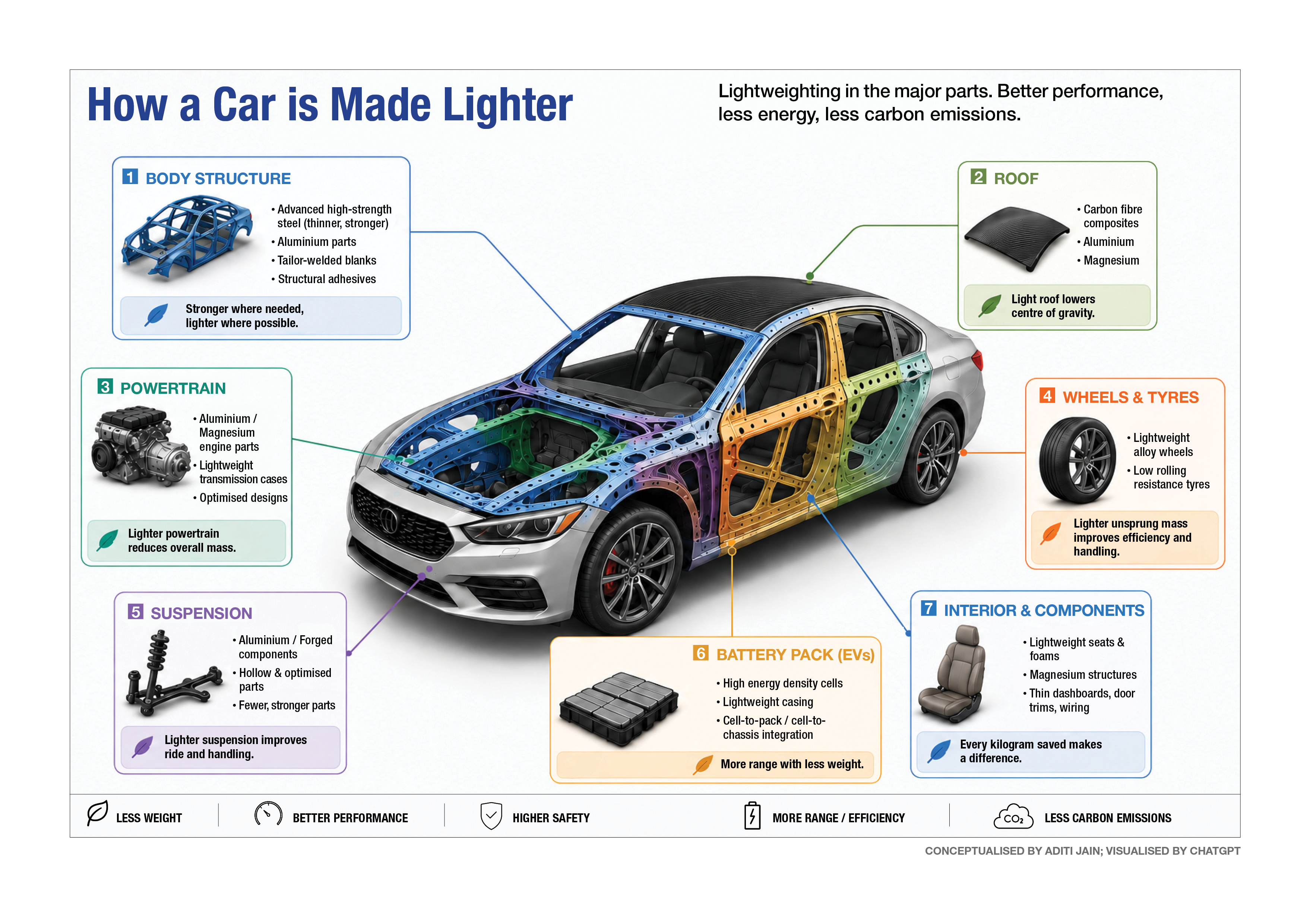
Reducing weight is now a matter of urgency for automobile manufacturers. Batteries increase the weight of electric vehicles, leading to range anxiety and therefore limiting their widespread use. "When I'm increasing the weight, more load is applied on the motor, (which) reduces the mileage," says Rahul Deb, R&D manager at Motovolt Mobility. Deb mentions that mileage is important for Indian customers and can affect a vehicle's sales. Auto firms are trying to develop advanced aluminium alloys that are strong and crash-resistant, along with advanced metal joining techniques and coatings to make them corrosion-resistant. Earlier in 2026, U.S.-based General Motors, in partnership with the Oak Ridge National Laboratory in the U.S., tested two new aluminium alloys — Cast ACMZ and DuAlumin-3D. Cast ACMZ is an affordable, high-strength aluminium alloy made of aluminium, copper, manganese, and zirconium, and used in making casting engine blocks and cylinder heads, while DuAlumin-3D is a high-temperature, 3D-printable aluminium alloy. Together, the two alloys in the engine enabled a 15% reduction in weight and more than 10% improvement in fuel efficiency.
Additive manufacturing technology has enabled scientists to replicate light, physics-driven designs in the lab and in manufacturing.
In India, researchers at the CSIR-National Institute for Interdisciplinary Science and Technology (NIIST) in Thiruvananthapuram have developed three aluminium alloys: modified Al-Si-Mg alloys for high-strength light structural parts, Al-Si-Cu alloys for suspension and functional automotive components, and high-temperature Al-Si-Cu-Ni-Mg alloys for engine and transmission parts. Aluminium- and copper-manufacturing company Hindalco, in collaboration with the Automotive Research Association of India (ARAI), has developed a series of aluminium-based vehicles: an aluminium bus which is 35% lighter than a conventional steel bus, an all-aluminium freight trailer which is 50% lighter than a steel trailer, and an all-aluminium freight rail rake which is 180 tonnes lighter than steel ones. For every 100 kg weight reduction of the wagon, the lifetime CO2 saving is 8-10 tonnes. This translates to a saving of more than 14,500 tonnes of CO2 for a single rake.
DESIGN AND GEOMETRY
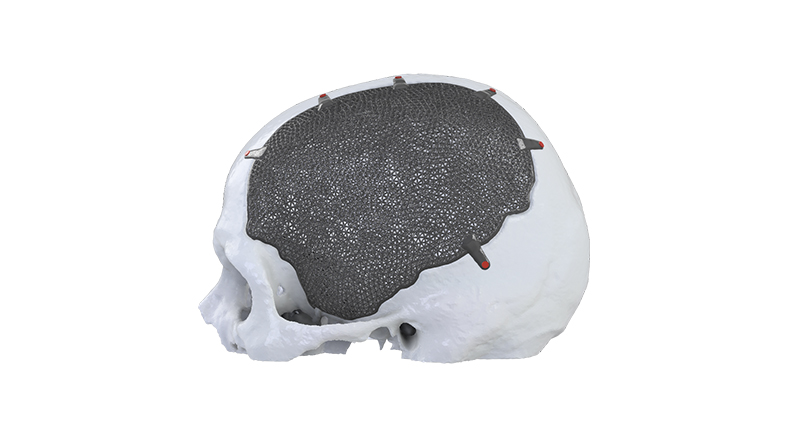
Murugaiyan Amirthalingam, a materials scientist and Associate Professor at IIT Madras, realised the problems posed by heavy titanium implants while collaborating with neurosurgeons of VHS Multispeciality Hospital, Chennai. Titanium has low density, but the solid plates were heavier than the bones they replaced. This extra weight was putting stress on neck muscles and the areas around the skull due to uneven load distribution, affecting balance and head movements. So, Amirthalingam's team decided to replace the solid plate with a lattice structure and make customised implants using 3D-printing technology.
MATERIAL WHIRLS
The global focus is on sustainable materials.
The global sustainability agenda ignited the need for lightweighting across industries, leading scientists and industries to look for lighter materials – especially those that were also environmentally friendly and recyclable. Metals can easily be recycled; however, relatively new materials such as aerogel and carbon fibre are now being designed keeping circularity in mind. For example, Kaushik Pal at the Indian Institute of Technology (IIT) Roorkee has developed a bio-based aerogel using cellulose, chitosan and aluminium ions in collaboration with the Indian Space Research Organisation. This aerogel has excellent insulation ability for use in spacecraft, automobiles and the construction industry.
Along with the use of biodegradable material, the focus is on designing for recyclability. For that, Suryasarathi Bose's team at the Indian Institute of Science in Bengaluru added a modified version of graphene oxide to a carbon fibre composite, which both increased its strength and made it recyclable, as the composite broke down to a polymer and carbon fibres when immersed in an eco-friendly mix of seawater and citric acid.
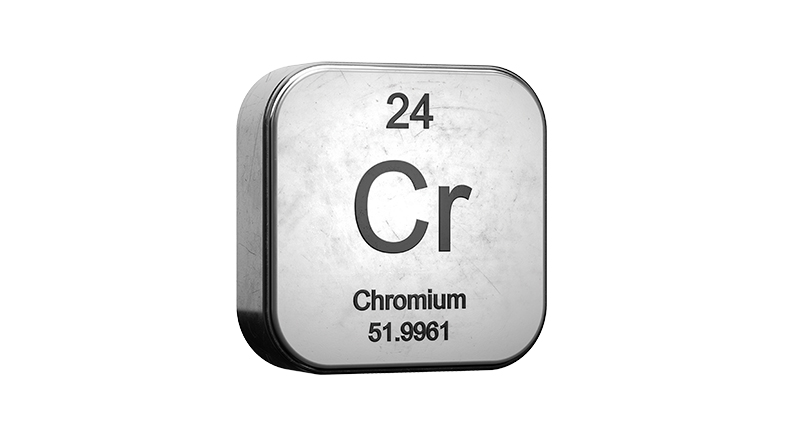
Researchers are also focusing on material sourcing. Murugaiyan Amirthalingam at IIT Madras says that researchers in the West have been looking at nickel for lightweighting at high temperatures as they have ample nickel reserves. India doesn't have such deposits, but produces chromium. "We are the largest producer of chromium. Nickel's density is 8.2, and chromium is 7.2, so significant lightweighting is possible," he says, emphasising the need to develop chromium alloys.
To develop a light and personalised cranial implant, the group developed an algorithm that takes the CT scan of a patient as input, defines the contours of deformity, and recreates the missing geometry from the other, intact side because the human skull is approximately symmetrical. The design is then optimised so that the implant weighs approximately the same as the missing part and is converted into a printable file. The printable file is used for printing the implant using a 3D printer. The printout obtained is cleaned, polished, sterilised and then implanted. The lattice configuration reduces the implant mass by 40-50% as compared to solid cranial implants.
"This is about 40 grams. If you take the same bone from the skull of the same size, it would also be the same amount, but if you make a solid titanium cranial implant, it will be around 120 grams," explains Amirthalingam. The lattice structure has another advantage: it promotes cell growth on its surface, making surgical rehabilitation faster.
In the past decade, additive manufacturing technology has helped scientists and engineers bring their ideas to reality. This has enabled scientists to replicate light, bioinspired and physics-driven designs in the laboratory and in manufacturing. "Earlier, there was less opportunity to play around with the designs because even if you came up with some kind of a fancy design, who was going to fabricate it for you," asks Biranchi Panda, a mechanical engineer and Assistant Professor at IIT Guwahati. Panda is using 3D-printing technology in his lab to develop material-efficient designs and products. So far, he has been using topology optimisation tools, but recently started using generative AI to develop designs that use material minimally and cautiously.
Lighter and more efficient cooling plates ultimately translate to better range and performance of electric vehicles.
In his recently published research, he has developed a generative AI model that designs the cooling plates of a battery with only 50% of the plate's volume allocated to the solid material and 50% to the fluid channels. The idea was to develop a material-efficient design that spreads the heat uniformly and reduces the pressure drop of coolant so that less energy is required for pumping coolant. The model was trained on the dataset generated from computer simulations. Generative AI produced a design that spread heat more uniformly and reduced the pressure drop by 20% compared to optimised designs. This generative AI model now obviates the need to carry out repeated computer simulations. Lighter and more efficient cooling plates ultimately translate to better range and performance of electric vehicles. "Let us say today composites are reducing compared to metals by about 30%. With generative designs and geometries, it can even bring it down to 50% or more," says Kanagaraj of Fabheads.
A product that is light in weight gives the advantage of sustainability throughout its lifecycle. At the manufacturing stage, it leads to resource efficiency, conserving natural resources. During distribution, every kilogram reduction cuts down the energy required to move goods, leading to lower fuel and electricity consumption and lower carbon emissions. In the case of vehicles, the benefits go beyond fuel economy, as weight reduction enhances acceleration, braking, handling, and payload capacity. Light medical devices and implants perform better. With weight reduction, more is done with less.
See also:









Gold-Star Telescopes
New observational tools and techniques are helping Indian scientists unearth the secrets of the universe.



A policy in need of a fix
Substance misuse is a deadly problem, but the remedy lies in decriminalisation and offering psychosocial support.



Have a
story idea?
Tell us.
Do you have a recent research paper or an idea for a science/technology-themed article that you'd like to tell us about?
GET IN TOUCH